What Steps Were Taken to Nor Make Hurricane Katrina Happen Again
Suggested Citation:"two New Orleans Earlier and Afterward Katrina." National Research Council. 2011. Increasing National Resilience to Hazards and Disasters: The Perspective from the Gulf Coast of Louisiana and Mississippi: Summary of a Workshop. Washington, DC: The National Academies Press. doi: 10.17226/13178.
×
2
New Orleans Before and After Katrina
Two speakers at the workshop provided historical perspectives on the experiences of New Orleans with hurricanes. Craig Colten, the Carl O. Sauer Professor of Geography at Louisiana State University, compared the experiences of New Orleans during Hurricane Betsy in 1965 and Hurricane Katrina in 2005 to track the evolution of resilience in the city over the past half century. Allison Plyer, co-deputy manager of the Greater New Orleans Customs Data Center, provided a statistical analysis of the New Orleans Metropolitan Area since Katrina to highlight both the accomplishments and the challenges of the post-Katrina period.
FORGETTING THE UNFORGETTABLE: CRAIG COLTEN
On September nine, 1965, Hurricane Betsy struck New Orleans with winds over 100 miles per hour. At the fourth dimension, except for the shore of Lake Pontchartrain, only modest barriers protected shorelines from flooding, and the city had more residents than it does today. The tempest, which inundated less than half the urban area of New Orleans, acquired considerable simply not overwhelming harm to residences, and the land of Louisiana suffered just over 80 deaths (Colten and Sumpter, 2008).
Almost exactly 40 years later, the city had a much more formidable hurricane protection levee organization, and the population of the metropolis had fallen from 627,000 residents in 1965 to circa 437,000 residents just before Katrina (Kates et al., 2006; Williamson, 2010). Notwithstanding a staggering number of homes were seriously flooded or destroyed, and the storm caused more than i,500 deaths throughout Louisiana (Kates et al., 2006).
Suggested Citation:"2 New Orleans Before and After Katrina." National Enquiry Quango. 2011. Increasing National Resilience to Hazards and Disasters: The Perspective from the Gulf Coast of Louisiana and Mississippi: Summary of a Workshop. Washington, DC: The National Academies Press. doi: ten.17226/13178.
×
After Hurricane Betsy, Louisiana Governor John McKeithen pledged that "zero like this volition happen once more" and asserted that his assistants would "establish procedures that will someday in the near future make a repeat of this disaster impossible." 40 years later a storm of lesser magnitude caused far worse impairment and fatalities. "Had the lessons of Betsy been retained?" asked Colten during his presentation. "Had they been woven into hurricane preparations and used to make the metropolis more resilient?" The reply has to be no. Resilience eroded in the city of New Orleans between the 2 events, Colten said. The city did not retain the lessons of past hurricanes, and it did not plan or set adequately for hereafter events. This erosion of resilience has implications for whatsoever other city that faces repeated disruptive events.
Resilience Defined
Colten defined resilience as the ability of a community to rebound after an farthermost or stressful upshot to either the aforementioned condition or to a functional state. This definition can apply to either ecological or homo communities, he observed. But human communities take the ability to learn, adapt, and accommodate to subsequent disruptive events, so long as they retain lessons learned in previous events and use those lessons to adapt to future events.
Given this definition, the term resilience implies a customs that anticipates problems, reduces vulnerabilities, responds effectively to an emergency, and recovers rapidly to a safer and fairer functional land. To achieve resilience, communities demand to brand deliberate efforts to infuse preparations with historical perspectives and to convey lessons to each generation of leaders, Colten said. They need to preserve, nurture, integrate, and perpetuate social memories of by events and use these memories as growth points for the renewal and reorganization of socioecological systems (Adger, 2000).
Changes Between 1965 and 2005
One area where there was significant improvement between the two hurricanes was in storm forecasting. The forecasting tools in 1965 included early radar systems, hurricane hunter flights, and networks of ship reports. Ii days earlier the landfall of Betsy, the city of New Orleans and federal officials had already launched full preparation for the hurricane. A mean solar day earlier landfall the warning expanse extended from Texas to Florida.
In 2005 the National Hurricane Middle produced a nearly perfect track for the hurricane 72 hours earlier landfall (eastward.one thousand., http://www.ncdc.noaa.gov/special-reports/katrina.html; accessed May 30, 2011). This emphatic alert provided impetus for the evacuation of able-bodied people and the provisioning of shelters, although many people with special needs still did non have enough fourth dimension to evacuate from the urban center.
Suggested Citation:"2 New Orleans Earlier and Later on Katrina." National Enquiry Council. 2011. Increasing National Resilience to Hazards and Disasters: The Perspective from the Gulf Declension of Louisiana and Mississippi: Summary of a Workshop. Washington, DC: The National Academies Press. doi: 10.17226/13178.
×
Colten identified iv central elements that have been involved in the loss of resilience between the two hurricanes: (1) alluvion-proof architecture, (2) protective structures and state use, (3) local evacuation and multiple shelters, and (4) the coordination of the organizational response. Colten offered a historical context to sympathise these factors earlier Hurricane Betsy and betwixt Betsy and Katrina.
Compages
From the colonial era into the 1920s, Colten noted that many New Orleans homes were elevated in a higher place the floodplain. This was usually done to brand them cooler in the summertime, but it as well provided protection against floods. Early on construction also often relied on waterproof materials such as cypress and tile, which provided some degree of resilience even when structures were not elevated.
After World War II, houses built on concrete slabs raised just a few inches above basis level largely replaced raised houses in the city limits. The city planning role noted that this slab on-grade housing was a error after the hurricane of 1947, but no steps were taken to restore safe construction. These houses became the ascendant type of construction and were allowed by building codes (Colten and Sumpter, 2008).
State Employ
After New Orleans was founded in 1718, early settlement clustered on the narrow high ground of natural levees near the river, which provided the but solid footing and were the last areas to overflowing and the first to drain afterwards flooding (Figure two-1). As the urban center grew during the 19th century, it spread along the loftier ground, fugitive more flood-prone areas (Kates et al., 2006).
In the 20th century, housing extended into more susceptible areas equally New Orleans became ane of the largest cities in the United States. Later on a devastating hurricane in 1915 drove storm surge across the lakefront and into the sprawling city, the city turned to structural protection. Information technology built a 9.5-human foot seawall on the lakefront, which was completed in 1934, to keep water out of the urban center's "back door." With that barrier in place, the metropolis expanded toward the lakefront during the economic boom of the 1920s, facilitated past public works programs that tuckered depression-lying areas and provided h2o and sewer lines. By the get-go of the Bully Low, the neighborhoods of Lakeview and Gentilly were developed, and the inhabitants believed them to be safety despite their low elevations (Kates et al., 2006; see maps in Appendix D for locations of New Orleans neighborhoods).
A 1947 hurricane rekindled concern, Colten indicated, but the lakefront levees provided expert protection, and developers felt information technology was safe to extend urban sprawl. The U.S. Army Corps of Engineers built the Jefferson Parish lakefront levee along with other levees to protect urban areas and waterways.
Suggested Citation:"2 New Orleans Before and Later on Katrina." National Enquiry Quango. 2011. Increasing National Resilience to Hazards and Disasters: The Perspective from the Gulf Declension of Louisiana and Mississippi: Summary of a Workshop. Washington, DC: The National Academies Press. doi: ten.17226/13178.
×
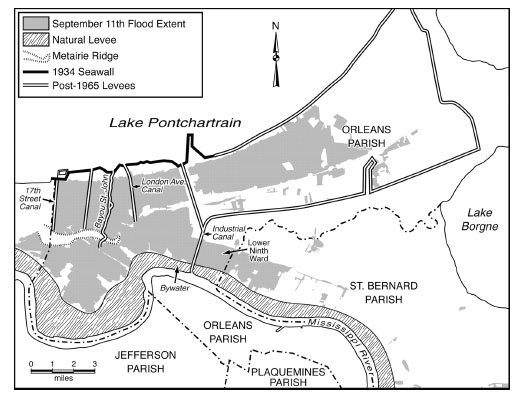
FIGURE ii-one Development occurred in areas protected past an expanding levee network betwixt 1900 and 2005. For additional maps, see Appendix D. SOURCE: Kates et al., 2006.
Following Hurricane Betsy, the city and land appealed for enhanced structural protection to what was so a modest organisation. The Corps of Engineers provided a programme to Congress in July 1965 for new levees, and the plan was approved. Progress cruel chronically behind schedule and the plan had not been finished in 2005, though information technology had originally been scheduled for completion in 1978 (USGAO, 2005; Colten and Sumpter, 2008).
Many of the new levees protected uninhabited areas, which meant that their cost could be justified merely if these areas were developed. With new levees in place, urban growth largely ignored prior floods. The levees excluded the entire city from the 100-year floodplain,ane though 67 percent of the city'southward homeowners had inundation insurance to guard against freshwater floods (Colten, 2005; Meitrodt and Mowbray, 2006).
____________
ane A 100-year floodplain is the area that volition be inundated past a flood having a one percent gamble of being equaled or exceeded in any given yr. See http://www.fema.gov/program/prevent/floodplain/nfipkeywords/flood_zones.shtm (accessed May 30, 2011).
Suggested Citation:"two New Orleans Before and After Katrina." National Research Council. 2011. Increasing National Resilience to Hazards and Disasters: The Perspective from the Gulf Declension of Louisiana and Mississippi: Summary of a Workshop. Washington, DC: The National Academies Press. doi: 10.17226/13178.
×
As levees were extended following Betsy, many new subdivisions were platted in areas that were flooded in 1965. For example, 22,000 new homes were built in New Orleans Due east between the 1960 and 1980 censuses, representing a massive expansion of housing in areas below ocean level. Jefferson Parish underwent dramatic growth during this period, with the population more doubling. Metropolitan New Orleans added 150,000 housing units between 1965 and 1985, most of them in areas behind new but uncompleted levees (Colten and Sumpter, 2008).
Another upshot of the widespread construction of levees was subsidence of the land. When the areas behind levees were tuckered, the land compacted and lowered, increasing the susceptibility of housing to farthermost damage if the levees failed or were overtopped.
Evacuation
During the 1965 hurricane, planning emphasized local evacuations. More than 180 shelters were available and easily accessible, so people could evacuate inside minutes. Many sturdy 2-story neighborhood schools were designated as shelters, providing safety, cooking facilities, and toilets. Other shelters included military bases that provided for basic needs. The state plan had enough food to provide for more than 400,000 people for 2 weeks before the storm, and cots were set upwards before the storm arrived (Colten and Sumpter, 2008).
On the eve of Hurricane Betsy, warnings were sent out to people living in lower littoral parishes, and city residents were urged past radio, television receiver, and newspapers to relocate to shelters. Evacuation routes marked in previous years showed the way, and more than 300,000 people evacuated low-lying coastal areas in Louisiana (Goudeau and Conner, 1967). Many walked or took public transit, so they were not dependent on private cars.
After Betsy, development outpaced available levels of protection. With the new levees, deep submersion of the city was possible, so it was no longer possible to evacuate locally. People would demand to evacuate long distances, which meant that evacuations would rely largely on individual automobiles. But many people had no access to private transportation. Also, many public facilities—such as hospitals, jails, and nursing homes—opted not to evacuate given the expense of doing so.
Although at to the lowest degree 800,000 people left the urban area in 2005 (http://www.dhs.gov/xfoia/archives/gc_1157649340100.shtm; accessed May 30, 2011), some 100,000 remained behind (Heitman, 2010), and in that location were inadequate provisions for those who did not evacuate. Some people were stranded in their homes. Others fled to neighborhood schools and broke into the buildings. Others went to the convention center after the storm, seeking rescue or supplies. Approximately 10,000 people congregated at the Superdome (Filosa, 2005), and people were told to bring 3 days' worth of their own food. Then the roof of the Superdome failed during the storm.
Suggested Commendation:"2 New Orleans Before and After Katrina." National Research Quango. 2011. Increasing National Resilience to Hazards and Disasters: The Perspective from the Gulf Coast of Louisiana and Mississippi: Summary of a Workshop. Washington, DC: The National Academies Printing. doi: 10.17226/13178.
×
Response
The primary planning for the response to Hurricane Betsy was done past the Department of Civil Defense, which maintained lists of shelters and coordinated response planning. The military also played an of import role, with the Declension Baby-sit performing rescues and the National Guard providing security, and local governments providing an array of police force, burn down, and other services. Though in that location was some criticism afterward Betsy about the need for greater coordination, there was a remarkable lack of bickering beyond levels of authorities, said Colten.
During Katrina, the National Weather Service did an beauteous job of forecasting the storm, and the urban center declared a mandatory evacuation with reasonable atomic number 82 times. But the failure of the levees disrupted response procedures and interfered with communications. While the Declension Guard and the burn down department were among the few organizations that received praise, the storm became a major social calamity, Colten indicated. The calibration of the effect exceeded the ability of organizations to reply at an appropriate scale. This failure at all levels led to finger pointing rather than a sense of shared responsibility, as later on Betsy.
Changes Since Katrina
In general, said Colten, the lessons that should take been learned from Betsy and other hurricanes were not heeded before Katrina, and many of these lessons still are non beingness heeded. Although the levees are under repair and new surge barriers are in place, the urban center'due south footprint has non been fundamentally reduced, even though the corps no longer considers the levees around New Orleans to provide protection against a 100-year flood event. Today, many houses in New Orleans are below sea level, and even some of the houses built afterward Katrina are sick suited for high water, said Colten.
After a protracted public process, New Orleans adopted a programme that opens the entire city to redevelopment while targeting certain areas for rebuilding, renewal, and redevelopment. Building can occur in almost of the areas that were flooded and remain susceptible to future floods.
Neat improvements have occurred in preparing for the evacuation of the infirm, equally demonstrated past the much more successful evacuation carried out before Hurricane Gustav in 2008, and plans have been made for the establishment of more than local shelters. All the same, long-distance evacuation remains the major response programme.
A congressional select commission concluded that many failures in the emergency response during Katrina were owing to inadequate cooperation and advice among government bodies responsible for training and response. Despite the emergence of spontaneous groups such equally Common Ground to fill this void, merging their efforts with those of existing agencies and nongovernmental organizations remains problematic, Colten indicated.
Suggested Citation:"2 New Orleans Earlier and Later Katrina." National Inquiry Quango. 2011. Increasing National Resilience to Hazards and Disasters: The Perspective from the Gulf Declension of Louisiana and Mississippi: Summary of a Workshop. Washington, DC: The National Academies Printing. doi: 10.17226/13178.
×
Resilience as a concept is gaining widespread application. But after a calamity, firsthand and deliberate steps need to be taken to identify and archive effective resilience techniques, Colten said. Social memories need to be perpetuated at all levels and all stages to enhance emergency response, recovery, and long-term reconstruction. Today, memories of Katrina remain potent, which has motivated modify. Will these memories notwithstanding exist motivating similar behaviors when the adjacent major hurricane strikes New Orleans?
THE NEW ORLEANS Index AT 5: ALLISON PLYER
The New Orleans Metropolitan Area has sustained three major shocks in the last five years: (1) Hurricane Katrina, (2) the economical recession that started in 2008, and (three) the oil spill caused by the explosion of the Deepwater Horizon drilling rig in 2010. However New Orleans is rebounding from all of these events, said Allison Plyer, co-deputy director of the Greater New Orleans Community Data Center. It has become more resilient and is better positioned to not merely arrange but transform itself in the futurity. Plyer added that key economic, social, and ecology trends in the New Orleans Metropolitan Area remain troubling and are testing the region's path to prosperity.
The Greater New Orleans Community Data Center publishes the New Orleans Index with the Brookings Institution, which began publishing the index after Hurricane Katrina. For the fifth anniversary edition of the index, the Community Data Center and the Brookings Institution examined trends in the New Orleans Metropolitan Area beyond the past 30 years to await more than securely at bug of resilience. The resulting analysis, along with seven essays on aspects of resilience and recovery past local scholars, are beingness included in a book published by the Brookings Institution Press (run across also Liu and Plyer, 2010)ii.
Measures of Prosperity
The New Orleans Alphabetize looks at four dimensions of prosperity: (i) economic growth, (2) inclusive growth, (3) sustainable growth, and (iv) quality of life. The metropolitan surface area includes the seven parishes of Orleans, Jefferson, St. Bernard, St. Charles, Plaquemines, St. John, and St. Tammany, though in some cases the analysis includes the three additional parishes of St. James, Tangipahoa, and Washington. The alphabetize also compares the New Orleans region to 57 "weak city"
____________
2 Allison Plyer's remarks are sourced from a report of the Brookings Establishment and the Greater New Orleans Community Data Center called "The New Orleans Index at Five: From Recovery to Transformation," released in August 2010 [http://www.brookings.edu/reports/2007/08neworleansindex.aspx]; the Power Indicate presented by Ms. Plyer derives from that written report and can be found hither: https://gnocdc.s3.amazonaws.com/NOIat5/NOLArecoveryBriefing.ppt. Both links accessed May 30, 2011.
Suggested Citation:"2 New Orleans Before and After Katrina." National Inquiry Council. 2011. Increasing National Resilience to Hazards and Disasters: The Perspective from the Gulf Declension of Louisiana and Mississippi: Summary of a Workshop. Washington, DC: The National Academies Press. doi: ten.17226/13178.
×
metropolitan regions—older industrial cities that, like New Orleans, accept experienced decades of relative economic decline.
Employment data for New Orleans testify a great deal of variation in the last 5 years (Figure ii-two). Information technology lost jobs immediately after Katrina, gained jobs during the initial stages of recovery, and and then lost jobs over again during the recession. However, New Orleans shed fewer jobs when the recession hit, losing only 1.4 percent of all jobs between 2008 and 2009 compared with 4.3 per centum nationally. Post-Katrina rebuilding and the relative force of the oil and gas industry helped the surface area weather the recession better than the norm (Liu and Plyer, 2010).
The index looks specifically at "regional consign industries" that serve customers outside the region. Every bit a wide rule of thumb, every export industry job supports about 2 local serving jobs. For instance, ane job in the oil and gas industry might support the equivalent of two dry out-cleaning jobs, with export industry jobs typically paying higher wages than local serving jobs, Plyer said.
The economy of the New Orleans Metropolitan Area has been diversifying (Effigy 2-3). Among regional consign industries, jobs in the oil and gas industry, shipping, and ship edifice have dropped since 1980, every bit have jobs in tourism
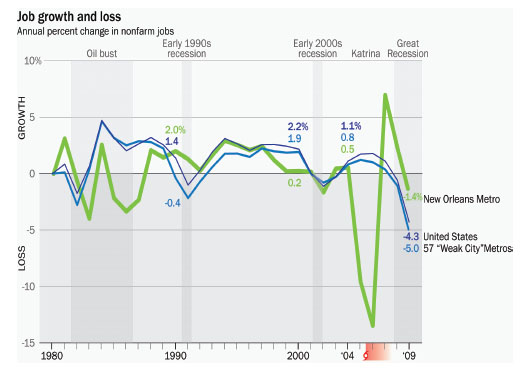
FIGURE 2-ii Job growth and loss in New Orleans (green line) rebounded after Katrina and did not reject equally much in the recent recession as the national average. SOURCE: Liu and Plyer, 2010.
Suggested Commendation:"ii New Orleans Before and Subsequently Katrina." National Enquiry Council. 2011. Increasing National Resilience to Hazards and Disasters: The Perspective from the Gulf Coast of Louisiana and Mississippi: Summary of a Workshop. Washington, DC: The National Academies Press. doi: x.17226/13178.
×
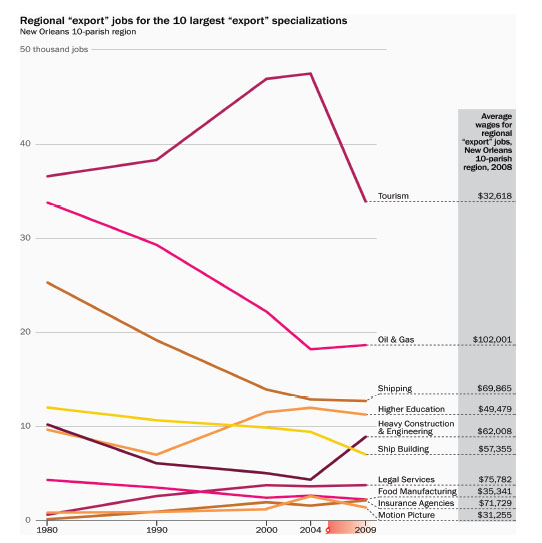
Figure 2-3 Regional consign jobs for the 10 largest export specializations have declined in traditional industries but are expanding in knowledge-based industries. SOURCE: Liu and Plyer, 2010.
since Katrina. In contrast, jobs in knowledge-based industries, such as higher education, legal services serving clients exterior the region, and insurance, have increased in number. In 2009, for example, jobs in higher education became the fourth largest economic commuter in the metropolitan area, exceeding shipbuilding, heavy construction, and engineering (Liu and Plyer, 2010).
Wages in the New Orleans Metropolitan Expanse accept grown by near xiv percent in the last v years—to about $45,000 in 2008 aggrandizement-adjusted dollars—budgeted the national average for the beginning time since the mid-1980s
Suggested Commendation:"2 New Orleans Before and After Katrina." National Research Quango. 2011. Increasing National Resilience to Hazards and Disasters: The Perspective from the Gulf Coast of Louisiana and Mississippi: Summary of a Workshop. Washington, DC: The National Academies Press. doi: 10.17226/13178.
×
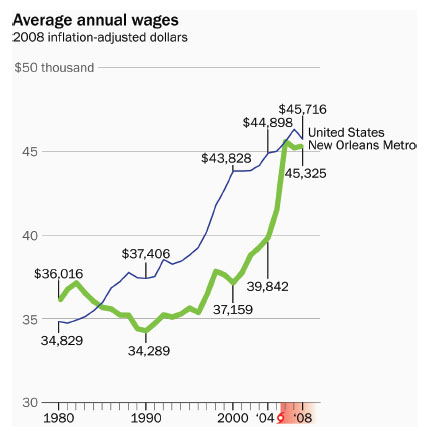
FIGURE ii-four Wages in New Orleans surged 14 pct after Katrina but have stagnated since 2006. SOURCE: Liu and Plyer, 2010.
(Figure ii-4). This increase in wages started before Katrina as cognition-based industries grew, and accelerated after the storm. The median household income too grew by four percent from 1999 to 2008 while national median household incomes declined. These changes are due to some extent to the loss of lower-paying jobs among people who could not afford to return to the New Orleans expanse afterwards the tempest. However, tracking where people have moved and what has happened to them after Katrina has been difficult, so the effects of demographic changes on boilerplate incomes are very difficult to determine.
The charge per unit at which New Orleanians are creating new businesses is college than the national average, afterward lagging behind the national boilerplate before Katrina. The number of arts and culture organizations in the city also grew from 2004 to 2007, from 81 to 86, despite the metropolis'southward smaller population after Katrina (Liu and Plyer, 2010).
A greater share of students attend schools that meet state standards of quality—59 pct compared with 30 per centum in 2004—which is also a tendency
Suggested Citation:"2 New Orleans Earlier and Afterward Katrina." National Research Council. 2011. Increasing National Resilience to Hazards and Disasters: The Perspective from the Gulf Coast of Louisiana and Mississippi: Summary of a Workshop. Washington, DC: The National Academies Press. doi: 10.17226/13178.
×
that accelerated after Katrina. Furthermore, these gains have occurred across all of the parishes (Liu and Plyer, 2010).
Resilience Factors
Plyer analyzed five factors that assistance determine resilience: (i) a stiff and diverse regional economic system, (2) large shares of skilled and educated workers, (3) wealth that can be deployed in strategic ways to adapt when a daze hits, (iv) stiff social capital, and (5) community competence.
Of these five, New Orleans has exhibited detail force in the last three since Katrina, she said. For case, information technology has experienced a significant increase in customs participation. More than New Orleanians are involved in shaping public policies. New Orleanians are "more likely than residents of other cities to attend public meetings… . Individuals and groups accept become more than strategic and sophisticated … and there is greater cooperation between organizations, including the emergence of new umbrella groups" (Liu and Plyer, 2010).
The recovery has seen the rise of sophisticated resident and community groups. These groups are pursuing holistic strategies to revive unabridged neighborhoods and are engaging in effective policy advancement to pursue economically integrated housing and neighborhoods, Plyer indicated. The federal government has "taken steps to overhaul the troubled housing authority," and depression-income households are being provided with quality, permanent, and affordable housing (Liu and Plyer, 2010).
After years of meetings, New Orleanians accept an canonical master plan designed to guide the city toward a modern and secure time to come that as well recognizes the civilization and history of the urban center (meet http://world wide web.nolamasterplan.org/; accessed May 30, 2011). The plan provides for predictable development and formalizes the customs participation process. "Citizens and civic leaders have also advocated for and won critical governance reforms, such as the consolidation of the levee boards, the merger of the city'south seven property assessors into ane office, [and] the cosmos of the Office
Suggested Citation:"ii New Orleans Earlier and Later on Katrina." National Research Quango. 2011. Increasing National Resilience to Hazards and Disasters: The Perspective from the Gulf Coast of Louisiana and Mississippi: Summary of a Workshop. Washington, DC: The National Academies Printing. doi: x.17226/13178.
×
of the Inspector General…." (Liu and Plyer, 2010).
In the area of didactics, the bulk of the schools in the New Orleans school district were converted to charter schools afterwards Katrina. Many school facilities have been upgraded, and new teachers have been recruited. A higher percentage of eighth and fourth graders are proficient in mathematics and English today than before the tempest (Liu and Plyer, 2010).
In health care, the metropolitan expanse now "provides admission to primary care and outpatient mental health services at 93 sites across 4 parishes… . Emergency room visits take declined as patients have increased their visits for preventive care" through this new system of wellness care delivery (Liu and Plyer, 2010).
In the criminal justice area, programs have begun to offer alternatives to incarceration. New legislation establishes an independent law monitor as role of the Inspector General'southward Function and new interagency partnerships across the criminal justice system (Liu and Plyer, 2010).
With respect to the coastal wetlands, acknowledged as important for inundation protection, the state created the Coastal Protection and Restoration Say-so. A programme for coastal restoration has as well been passed by the country, and the demand for improve state-use and land-use direction plans has been recognized, including the adoption of a statewide building lawmaking (Liu and Plyer, 2010). At the federal level, the Obama administration released a roadmap to guide federal efforts to restore coastal ecosystems of Louisiana and Mississippi (see http://www.whitehouse.gov/administration/eop/ceq/initiatives/gulfcoast/roadmap; accessed May 30, 2011).
All of these reforms "need a lot more work," said Plyer, but many were "essentially unimaginable earlier the tempest."
Remaining Obstacles
Despite this progress, several indicators signal to continuing difficulties as New Orleans seeks to recover from Katrina. First, money remains a serious constraint. Hurricanes Katrina and Rita combined acquired an estimated $150 billion in amercement beyond the Gulf Coast. The federal regime spent an estimated $126 billion on the recovery attempt, merely much of that money went to such short-term measures equally emergency rescue operations and brusk-term housing. Only virtually $45 billion of that coin went to rebuilding. Individual insurance provided about $30 billion for reconstruction, and philanthropies provided about $half dozen billion—iii times as much as for whatever other event in history. Even with expenditures of that magnitude, a gap of about $70 billion remains (Ahlers et al., 2008). "We are going to see the effects of Katrina in our communities for probably our lifetime because there's non enough money to rebuild."
Furthermore, major industries, including oil and gas, and shipping, accept all declined since 1980. To some extent, a rise in tourism made up for the loss of jobs in oil and gas, but the number of tourism jobs is now lower than in 1980. The Deepwater Horizon disaster reinforced how vulnerable many industries in the region are to water-related disasters, though the 2010 oil spill provides an opportunity to utilise some of the funds from BP (British Petroleum) to clean up and restore the wetlands that protect the city.
Also, New Orleans may have lost educated workers afterwards the tempest. In 2008 the share of college-educated workers in New Orleans remained unchanged from 2000 at about 23 per centum, but this number grew nationally (Liu and Plyer, 2010).
Income disparities remain stark among whites, Hispanics, and African Americans in New Orleans. Black and Hispanic household incomes are 45 and 25 percent lower than for whites, respectively. The New Orleans African American population has even lower household incomes than the national boilerplate for African Americans. The suburban parishes now house the majority of the metro-
Suggested Citation:"ii New Orleans Earlier and After Katrina." National Research Quango. 2011. Increasing National Resilience to Hazards and Disasters: The Perspective from the Gulf Coast of Louisiana and Mississippi: Summary of a Workshop. Washington, DC: The National Academies Press. doi: 10.17226/13178.
×
politan area'south poor (Liu and Plyer, 2010). This tendency started earlier Katrina and is consequent with the national trend of the suburbanization of poverty.
Despite the growth in average wages and median household incomes in the metropolitan area, "renters in the city and suburbs still pay too much of their earnings toward housing" (Liu and Plyer, 2010). In Orleans Parish, 58 percent of renters, and 45 pct of renters in the metropolitan area, pay more than 35 percentage of their pretax household income toward housing, compared with 41 pct of renters nationally. Homeowners in New Orleans also bear a college cost brunt than is the boilerplate nationwide (Liu and Plyer, 2010).
"Violent crimes and property crimes take risen" since Katrina "and remain to a higher place national rates," (Liu and Plyer, 2010) though they are lower than they were in 1990. The rates for both types of crimes in Orleans Parish are well-nigh double the national rates, Plyer said.
Meanwhile, littoral wetlands have connected to erode. More than than 23 pct of the land around the New Orleans Metropolitan Surface area has been lost since measurements began in 1956; the touch on of the oil disaster on the wetlands has non yet been measured (Liu and Plyer, 2010).
Principles for Recovery
Much of the recovery since Katrina has been aimed at bringing the city back to where it was before the disaster. But that is non enough, Plyer said. The goal must be transformation, not just preserving the status quo. In this regard, she identified iii key principles for continuing the recovery.
The first is to sustain and build on post-Katrina reforms. Specific ideas suggested in Liu and Plyer (2010) include
• Increasing the pool of qualified teachers.
• Providing "sustained gap funding for customs-based health centers."
• Building "capacity within local government to drive … improvements" amidst criminal justice agencies.
• Not rescinding or reallocating unspent hurricane recovery dollars and rather using those funds to address unmet housing needs, neighborhood rehabilitation, and customs chapters.
The second principle is to comprehend new opportunities presented by the recession and oil spill. Liu and Plyer (2010) suggest
• Investment in the restoration of coastal wetlands, and advancing the arroyo to alive with water.
• Diversification of the economy, including the energy sector.
• Challenging entrepreneurs to generate creative concern ideas that strengthen legacy industries.
Suggested Commendation:"two New Orleans Before and Later Katrina." National Enquiry Council. 2011. Increasing National Resilience to Hazards and Disasters: The Perspective from the Gulf Coast of Louisiana and Mississippi: Summary of a Workshop. Washington, DC: The National Academies Press. doi: 10.17226/13178.
×
• Expanding international consign chapters through port modernization and multimodal freight strategies.
• "Increasing the capacity of small businesses, especially minority- and women-owned businesses," to participate in growth sectors.
The third principle is to strengthen "regional resilience to minimize future shocks and shape the future course" of events (Liu and Plyer, 2010). In this area, Liu and Plyer (2010) suggest that New Orleans should
• Diversify its economy and increase skills.
• "Aggrandize local 'wealth' (e.chiliad., revenue enhancement base of operations, individual investment, philanthropy) to match outside resources."
• "Continue to nurture an open social club where engagement, networks, partnerships, and collaborations can evolve organically."
• "Assist maintain citizen participation as the community transitions from 'crisis' to implementation."
Condign resilient is a marathon and not a dart, Plyer concluded.
Give-and-take
During the word period, Plyer was asked about her vision for New Orleans in 2050. She responded that New Orleans has tremendous potential to pb in such areas as renewable energies, for case, past redeploying scientists and engineers involved in the oil and gas industries. Sectors of the U.S. economy, such as the military, and unabridged countries, such as Cathay, have made a delivery to renewable energy, and then a market exists. New Orleans culture has not emphasized innovation in the past, just the numbers of entrepreneurs in the metropolis take grown since Katrina. "It's a matter of industry, will, and intention."
New Orleans besides has the unique advantage of the Mississippi River, which it could apply to increase its role in an export economy. The United States has many products that could exist sold abroad, and the land needs to reverse its trade imbalances. New Orleans exists because of its port, and reforms to the port'south governance and infrastructure could make the metropolis a vibrant identify. "We have allowed other ports to greatly supersede our capacity, like Mobile, Houston, et cetera, but they don't have the Mississippi River."
Finally, many new people are moving to New Orleans, which is changing the city's civilization. "We enjoy Mardi Gras, merely we're going to proceed pushing to make it a modern city with a vibrant and future-oriented economy." Issues of inclusion and equity too need to exist addressed as the metropolis's civilization changes, "because we tin't exist prosperous unless everybody is prosperous." Changing the culture is a lot of hard work, but the urban center already has a culture different that of any other urban center. Building on that culture could create a new future for the city.
Suggested Commendation:"ii New Orleans Earlier and Later Katrina." National Research Quango. 2011. Increasing National Resilience to Hazards and Disasters: The Perspective from the Gulf Coast of Louisiana and Mississippi: Summary of a Workshop. Washington, DC: The National Academies Press. doi: ten.17226/13178.
×
In response to a question nigh the privatization of governmental services, Plyer responded that more evidence is needed to make generalizations that use across sectors. In some cases the privatization of services in New Orleans afterwards Katrina has had benefits, merely in other cases the privatization of services has been tremendously inefficient. Information technology "bends both ways."
Plyer also said that people in every neighborhood in the urban center tend to express the stance that other neighborhoods are receiving more than coin than is their neighborhood. Even so, tracking the verbal expenditures of recovery funds is very difficult. "Can nosotros say for certain that Lower Nine is getting less than Lakeview? I don't know that there are whatever numbers that could show that. What we encourage folks to practice is actually to continue to build their capacity to advocate for what they need in their neighborhood."
Finally, in response to a question virtually climatic change, Plyer observed that the U.S. Army Corps of Engineers has been deputed to build levees that volition protect the city against a 100-year tempest. Simply that level of protection will non be acceptable in the future. Many people in the city have become interested in the overflowing protection measures being built in kingdom of the netherlands, where protection against an xi,000-year tempest is the goal. Pursuing such a goal for New Orleans would require a tremendous endeavor. "It's not going to happen overnight, but the folks who understand what information technology's going to have for the metropolis to be sustainable will not give up that fight, considering folks are not fooled into thinking that the levees will be sufficient."
Suggested Citation:"2 New Orleans Earlier and After Katrina." National Enquiry Council. 2011. Increasing National Resilience to Hazards and Disasters: The Perspective from the Gulf Coast of Louisiana and Mississippi: Summary of a Workshop. Washington, DC: The National Academies Printing. doi: 10.17226/13178.
×
This folio intentionally left blank.
Source: https://www.nap.edu/read/13178/chapter/4
0 Response to "What Steps Were Taken to Nor Make Hurricane Katrina Happen Again"
Post a Comment