What Are 2 Sources Paleolithic People Used to Create Cave Art?
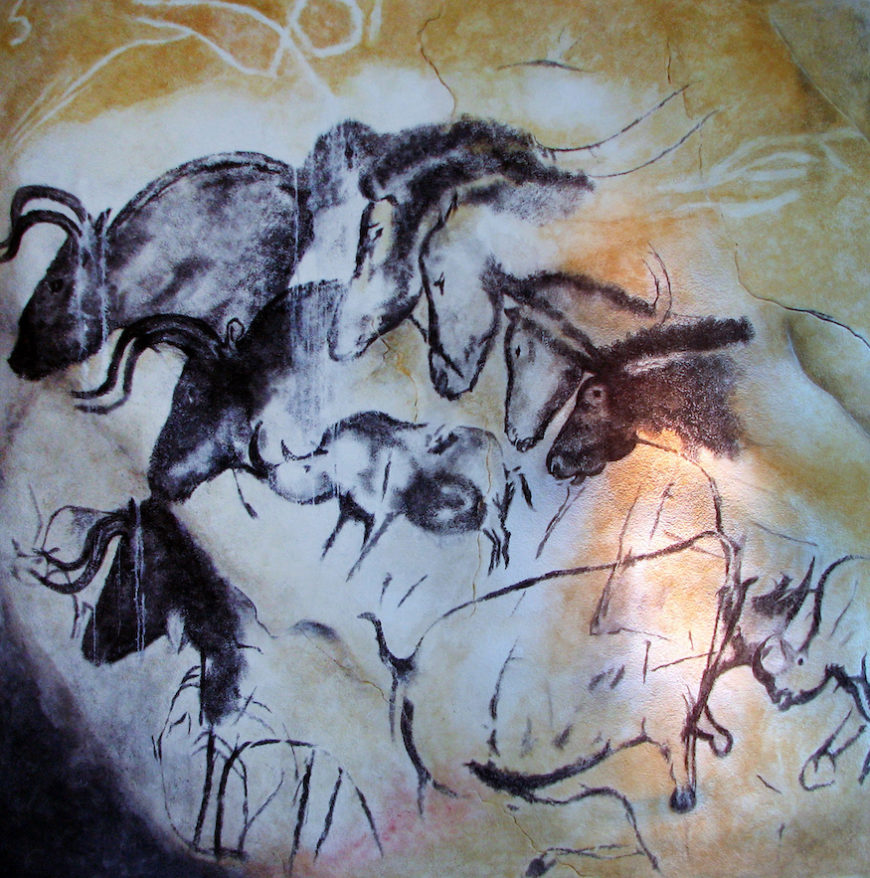
Replica of the painting from the Chauvet-Pont-d'Arc Cave in southern France (Anthropos museum, Brno)
The oldest art: decoration
Humans (Human being sapiens) brand fine art. We do this for many reasons and with whatever technologies are bachelor to us. Recent research suggests that Neanderthals also made art.
Extremely one-time, non-representational ornamentation has been found across Africa. The oldest firmly-dated example is a drove of 82,000 year old Nassarius snail shells found in Morocco that are pierced and covered with red ochre. Wear patterns suggest that they may take been strung beads. Nassarius crush beads found in State of israel may be more than 100,000 years old and in the Blombos cave in South Africa, pierced shells and minor pieces of ochre (red Hematite) etched with simple geometric patterns have been institute in a 75,000-year-old layer of sediment.
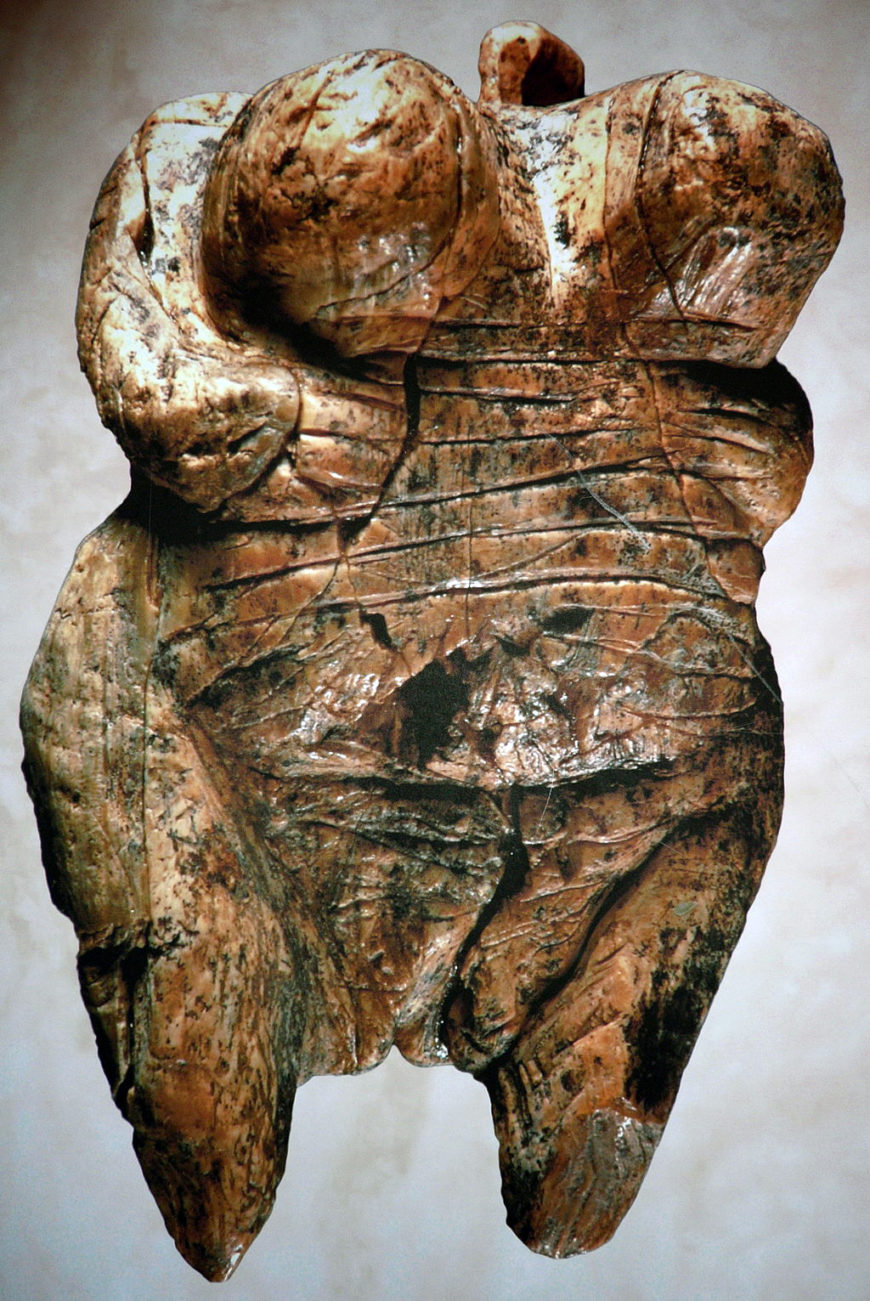
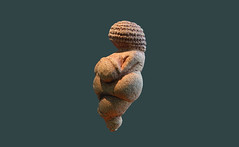
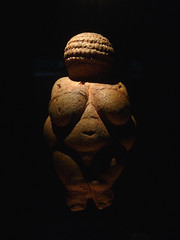
Female Figure of Hohlefels, c. 35,000 B.C.Due east., ivory, found in cave near Schelklinge, southern Germany (photo: Ramessos, CC Past-SA 3.0)
The oldest representational fine art
Some of the oldest known representational imagery comes from the Aurignacian culture of the Upper Paleolithic menstruum (Paleolithic means onetime rock age). Archaeological discoveries beyond a wide swath of Europe (specially Southern French republic, Northern Spain, and Swabia, in Frg) include over two hundred caves with spectacular Aurignacian paintings, drawings, and sculpture that are among the earliest undisputed examples of representational image-making. Among the oldest of these is a 2.4-inch tall female figure carved out of mammoth ivory that was establish in six fragments in the Hohle Fels cave near Schelklingen in southern Germany. It dates to 35,000 B.C.East.
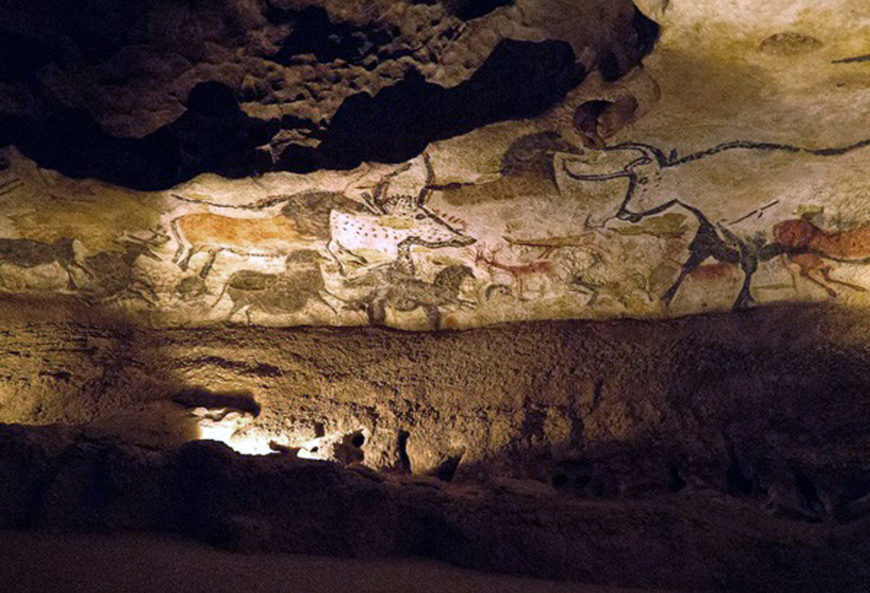
Left wall of the Hall of Bulls, Lascaux II (replica of the original cave, which is closed to the public), original cave: c. 16,000–fourteen,000 B.C.E., 11 feet half dozen inches long
The caves
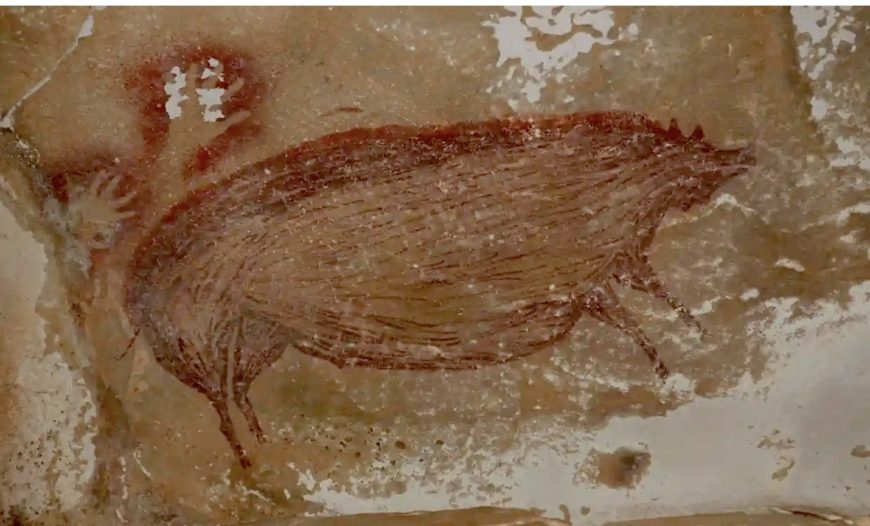
Warty sus scrofa (Sus celebensis), c. 43,900 B.C.Due east., painted with ocher (clay paint), Maros-Pangkep caves, Leang Bulu' Sipong 4, South Sulawesi, Republic of indonesia
The caves at Chauvet-Pont-d'Arc, Lascaux, Pech Merle, and Altamira comprise the best known examples of pre-historic painting and cartoon. Here are remarkably evocative renderings of animals and some humans that employ a circuitous mix of naturalism and abstraction. Archaeologists that study Paleolithic era humans, believe that the paintings discovered in 1994, in the cave at Chauvet-Pont-d'Arc in the Ardéche valley in French republic, are more than than 30,000 years onetime. The images found at Lascaux and Altamira are more than contempo, dating to approximately 15,000 B.C.E. The paintings at Pech Merle date to both 25,000 and xv,000 B.C.East. The world's oldest known cave painting was found in Sulawesi, Republic of indonesia in 2017 and was made at least 45,500 years ago.
Questions
What tin we really know about the creators of these paintings and what the images originally meant? These are questions that are difficult enough when nosotros study fine art made simply 500 years ago. It is much more than perilous to assert pregnant for the art of people who shared our anatomy merely had non yet developed the cultures or linguistic structures that shaped who we accept become. Do the tools of fine art history even utilise? Here is evidence of a visual language that collapses the more than ane,000 generations that divide us, but we must exist cautious. This is peculiarly and then if we want to understand the people that made this art every bit a style to empathize ourselves. The want to speculate based on what we encounter and the physical testify of the caves is wildly seductive.
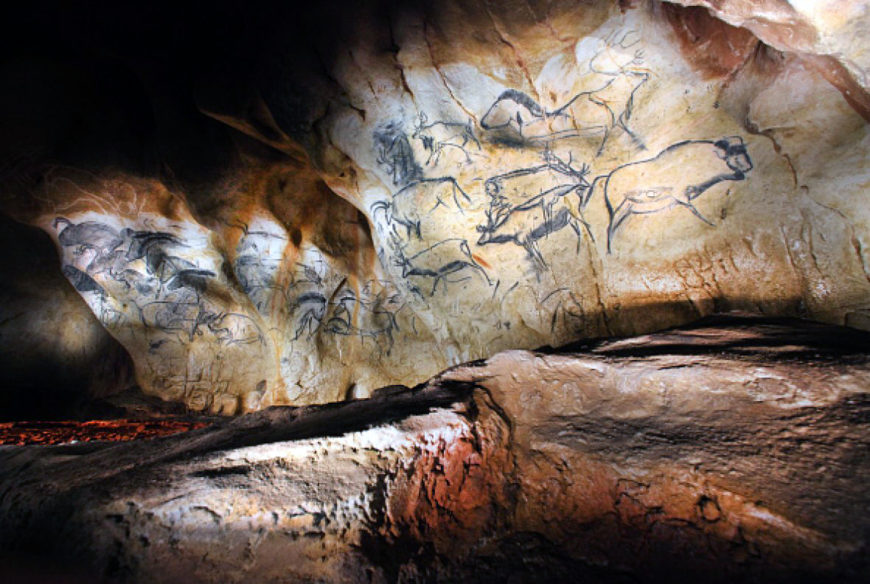
Replica of the painting from the Chauvet-Pont-d'Arc Cavern in southern France
Chauvet-Pont-d'Arc
The cave at Chauvet-Pont-d'Arc is over 1,000 feet in length with two large chambers. Carbon samples date the charcoal used to draw the two caput-to-caput Rhinoceroses (see the epitome to a higher place, bottom right) to between 30,340 and 32,410 years before 1995 when the samples were taken. The cave's drawings describe other large animals including horses, mammoths, musk ox, ibex, reindeer, aurochs, megaceros deer, panther, and owl (scholars note that these animals were not and then a normal part of people's diet). Photographs show that the cartoon at the top of this essay is very carefully rendered simply may be misleading. We see a group of horses, rhinos, and bison and nosotros run into them every bit a group, overlapping and skewed in scale. But the photograph distorts the mode these animal figures would accept been originally seen. The bright electric lights used past the photographer create a broad flat scope of vision; how dissimilar to see each animal emerge from the night under the flickering low-cal cast by a flame.
A word of caution
In a 2009 presentation at University of California San Diego, Dr. Randell White, Professor of Anthropology at New York Academy, suggested that the overlapping horses pictured above might stand for the same horse over fourth dimension, running, eating, sleeping, etc. Perhaps these are far more sophisticated representations than we have imagined. In that location is another cartoon at Chauvet-Pont-d'Arc that cautions usa confronting set assumptions. It has been interpreted as depicting the thighs and genitals of a woman only there is also a drawing of a bison and a king of beasts, and the images are most intertwined. In addition to the drawings, the cave is littered with the skulls and basic of cavern bear and the track of a wolf. There is too a footprint idea to accept been fabricated by an eight-year-sometime boy.
Additional resources:
Is this cave painting humanity's oldest story?
In our time: cavern fine art
U-Th dating of carbonate crusts reveals Neandertal origin of Iberian cavern fine art
Neanderthal artists made oldest-known cave paintings
Earth's oldest known cavern painting found in Indonesia
Grunter Painting May Be World'due south Oldest Cave Art Notwithstanding, Archaeologists Say
The cave of Chauvet-Pont-d'Arc
A carved female figurine dating to at least 35,000 years agone recovered from caves in the Hohle Fels region of Germany (video)
Lascaux: a visit to the cave
Lascaux on The Metropolitan Museum of Fine art'south Heilbrunn Timeline of Art History
For instructors: related lesson plan on Art History Teaching Resources
Smarthistory images for teaching and learning:





More than Smarthistory images…
Source: https://smarthistory.org/paleolithic-art-an-introduction/
0 Response to "What Are 2 Sources Paleolithic People Used to Create Cave Art?"
Post a Comment