What Age Does a Child Learn to Read
What is the all-time age to learn to read?
(Image credit:
Ozge Elif Kizil/Anadolu Agency via Getty Images
)
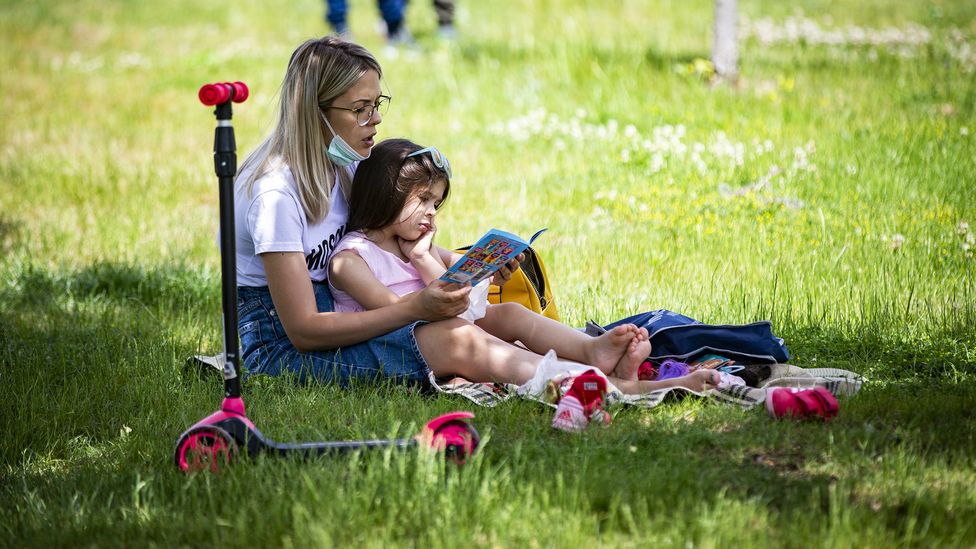
In some countries, kids as immature as four larn to read and write. In others, they don't start until seven. What's the best formula for lasting success? Melissa Hogenboom investigates.
I
I was seven years old when I started to acquire to read, equally is typical of the alternative Steiner school I attended. My own daughter attends a standard English school, and started at four, as is typical in most British schools.
Watching her memorise letters and sound out words, at an age when my thought of instruction was climbing copse and jumping through puddles, has fabricated me wonder how our different experiences shape usa. Is she getting a crucial head-get-go that will requite her lifelong benefits? Or is she exposed to undue amounts of potential stress and pressure level, at a time when she should be enjoying her freedom? Or am I simply worrying as well much, and it doesn't matter at what historic period nosotros first reading and writing?
In that location's no doubt that linguistic communication in all its richness – written, spoken, sung or read aloud – plays a crucial role in our early development. Babies already reply meliorate to the linguistic communication they were exposed to in the womb. Parents are encouraged to read to their children before they are even built-in, and when they are babies. Bear witness shows that how much or how footling nosotros are talked to equally children can take lasting effects on future educational accomplishment. Books are a particularly important aspect of that rich linguistic exposure, since written language often includes a wider and more nuanced and detailed vocabulary than everyday spoken language. This can in turn assistance children increase their range and depth of expression.
Since a child's early experience of language is considered so cardinal to their afterward success, it has become increasingly common for preschools to begin instruction children basic literacy skills even before formal education starts. When children begin school, literacy is invariably a major focus. This goal of ensuring that all children acquire to read and write has get even more than pressing as researchers warn that the pandemic has caused a widening achievement gap between wealthier and poorer families, increasing academic inequality.
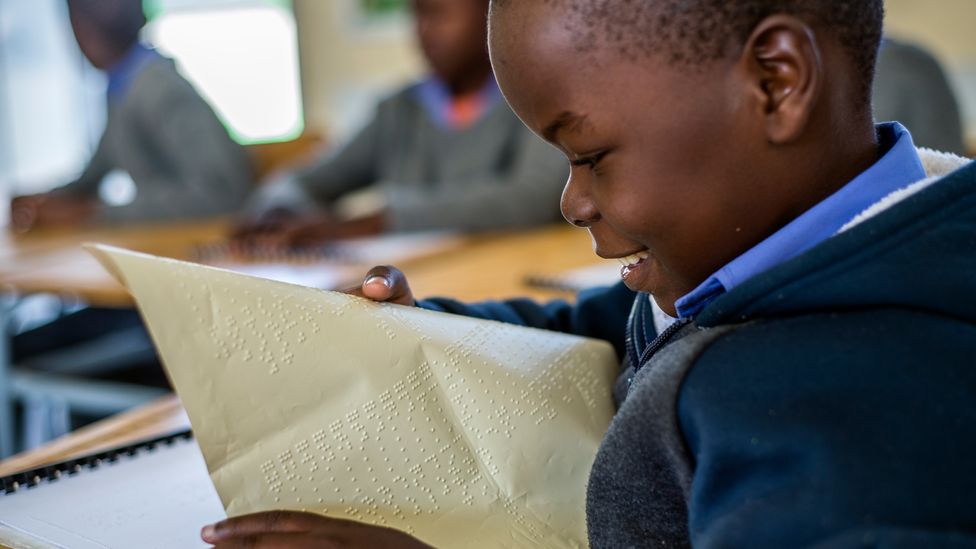
There are many ways to enjoy reading. In this Namibian schoolhouse, blind and visually impaired children learn the Braille script (Credit: Oleksandr Rupeta/NurPhoto/Getty Images)
Family unit Tree
In many countries, formal didactics starts at 4. The thinking oftentimes goes that starting early gives children more time to learn and excel. The outcome, however, can be an "education arms race", with parents trying to requite their kid early advantages at school through individual coaching and teaching, and some parents fifty-fifty paying for children as young as 4 to have additional individual tutoring.
Compare that to the more play-based early on education of several decades ago, and yous can encounter a huge modify in policy, based on very different ideas of what our children need in order to go alee. In the United states of america, this urgency sped upward with policy changes such every bit the 2001 "no child left behind" act, which promoted standardised testing as a way to mensurate educational performance and progress. In the Uk, children are tested in their second yr of schoolhouse (historic period 5-half dozen) to check they are reaching the expected reading standard. Critics warn that early testing like this can put children off reading, while proponents say it helps to identify those who demand additional support.
However, many studies evidence little do good from an early overly-academic surround. I 2015 US written report says that club'southward expectations of what children should achieve in kindergarten has changed, which is leading to "inappropriate classroom practices", such every bit reducing play-based learning.
The risk of "schoolification"
How children acquire and the quality of the environment is hugely important. "Young children learning to read is i of the most important things main didactics does. It'southward fundamental to children making progress in life," says Dominic Wyse, a professor of primary education at University Higher London, in the UK. He, alongside sociology professor Alice Bradbury, also at UCL, has published enquiry proposing that the way nosotros teach literacy really matters.
In a 2022 report, they state that English school system's intense focus on phonics – a method that involves matching the sound of a spoken word or letter, with individual written messages, through a process chosen "sounding out" – could be failing some children.
A reason for this, says Bradbury, is that the "schoolification of early years" has resulted in more formal learning earlier on. Just the tests used to assess that early learning may have piddling to practice with the skills really needed to read and savor books or other meaningful texts.
For example, the tests may enquire pupils to "sound out" and spell nonsense words, to prevent them from merely guessing, or recognising familiar words. Since nonsense words are non meaningful language, children may notice the task difficult and puzzling. Bradbury found that the pressure to gain these decoding skills – and pass reading tests – too means that some iii-year-olds are already being exposed to phonics.
"It doesn't finish upwards being meaningful, it ends up being memorising rather than understanding context," says Bradbury. She also worries that the books used are not especially engaging.
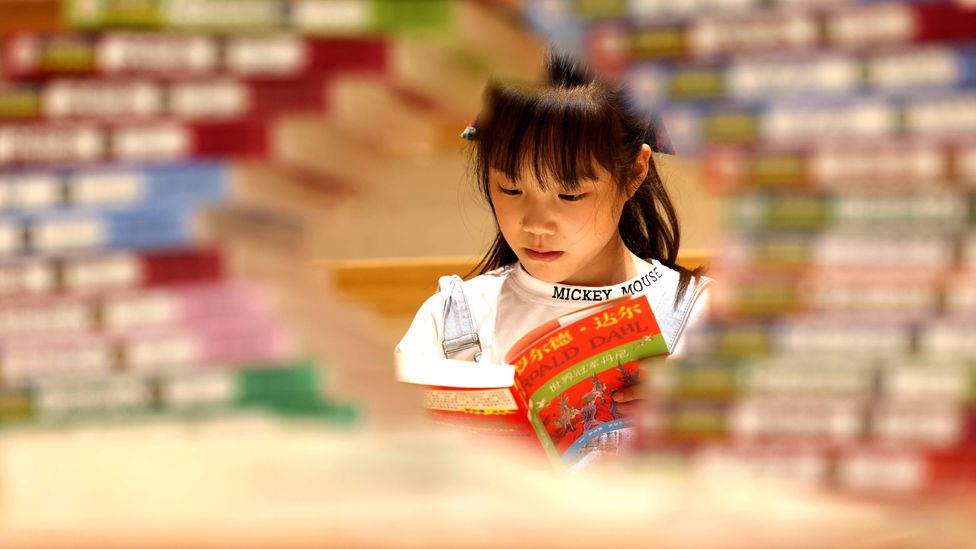
Linguistic communication in all its richness – written, spoken, sung or read aloud – plays a crucial role in our early development (Credit: Xie Chen/VCG via Getty Images)
Neither Wyse nor Bradbury make the case for later on learning per se, but rather highlight that we should rethink the way children are taught literacy. The priority, they say, should exist to encourage an interest in and familiarity with words, using storybooks, songs and poems, all of which assist the kid pick upward the sounds of words, as well as expanding their vocabulary.
This thought is backed up past studies that testify that the academic benefits of preschool fade away afterwards on. Children who nourish intensive preschools practise not have higher academic abilities in after grades than those who did non nourish such preschools, several studies now testify. Early on education tin can however have a positive touch on social evolution – which in plow feeds into the likelihood of graduation from schoolhouse and university as well as being associated with lower law-breaking rates. In short, attending preschool tin can have positive effects on later achievement in life, merely not necessary on academic skills.
Likewise much academic pressure may even cause problems in the long run. A report published in January 2022 suggested that those who attended a state-funded preschool with a strong academic emphasis, showed lower bookish achievements a few years later on, compared to those who had non gained a place.
This chimes with research on the importance of play-based learning in the early years. Child-led play-based preschools have improve outcomes than more academically focussed preschools, for example.
One 2002 study found that "children'due south later school success appears to have been enhanced by more active, child-initiated early learning experiences", and that overly formalised learning could have slowed progress. The study concluded that "pushing children as well soon may actually backfire when children move into the later on elementary school form".
Similarly, some other pocket-size study found that disadvantaged children in the US who were randomly assigned to a more play-based setting had lower behavioural issues and emotional impairments at historic period 23, compared to children who had been randomly assigned to a more "direct instruction" setting.
Preschool studies similar these don't shed light on the affect of early on literacy per se, and small studies in single locations must e'er be treated with care, but they suggest that how information technology is taught, matters. One reason why early education can result in positive social outcomes later in life may have naught to practise with the teaching at all, but with the fact that it provides childcare. This means parents can work uninterrupted and provide more income to the family dwelling house.
Anna Cunningham, a senior lecturer in psychology at Nottingham Trent University who studies early literacy, argues that if a setting is likewise academically focused early on, it can cause the teachers to become stressed over tests and results, which tin can in turn affect the kids. "Of course it's not good to judge a five-yr-old on their results," she says. Parental anxiety about how well their kid is doing at schoolhouse can besides feed into this: according to a survey deputed past an educational clemency in the UK, school operation is i of parents' meridian concerns.
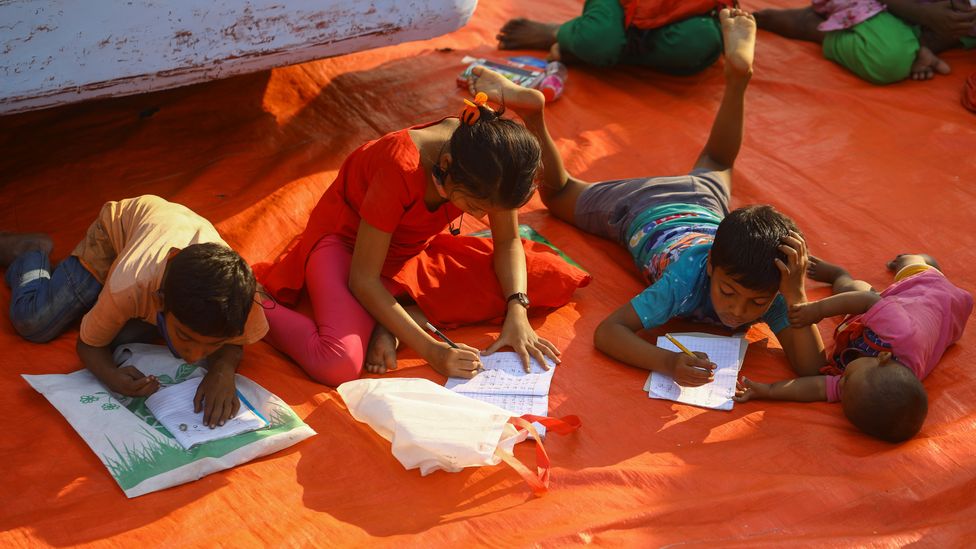
With the correct support, children tin can learn to read in a wide range of settings, like this open-air school in Dhaka, People's republic of bangladesh (Credit: Anadolu Agency via Getty Images)
Subsequently start, meliorate outcomes?
Non everyone favours an early on offset. In many countries, including Germany, Iran and Japan, formal schooling starts at around six. In Finland, oftentimes hailed every bit the country with 1 of the all-time teaching system in the world, children brainstorm school at seven.
Despite that apparent lag, Finnish students score higher in reading comprehension than students from the UK and the The states at age 15. In line with that child-centred approach, the Finnish kindergarten years are filled with more play and no formal bookish instruction.
Following this model, a 2009 Academy of Cambridge review proposed that the formal school age should be pushed dorsum to 6, giving children in the UK more than time "to begin to develop the language and study skills essential to their afterwards progress", every bit starting likewise early could "run a risk denting 5-year-olds' confidence and causing long-term damage to their learning".
Enquiry does dorsum upward this idea of starting afterward. One 2006 kindergarten report in the U.s.a. showed at that place was improvement in test scores for children who delayed entry by one year.
Other research comparing early versus late readers, found that later readers take hold of up to comparable levels afterwards on – even slightly surpassing the early readers in comprehension abilities. The study, explains lead author Sebastian Suggate, of the University of Regensburg in Germany, shows that learning later allows children to more efficiently match their cognition of the world – their comprehension – to the words they learn. "It makes sense," he says. "Reading comprehension is language, they've got to unlock the ideas behind information technology."
"Of course if you spend more than time focusing on language earlier on, you are building a strong foundation of skills that takes years to develop. Reading can be picked up speedily but for language (vocabulary and comprehension) there's no cheap tricks. It'southward hard work," says Suggate. In other work looking at differing school entry ages, he found that learning to read early had no discernible benefits at age fifteen.
The question remains that if reading power is not improved by learning early, then why start early on? Individual variation in reading appetite and ability are one of import aspect.
"Children are hugely different in terms of their foundational skills when they start school or start learning to read," explains Cunningham. In her study of Steiner-educated children, who only beginning formal didactics at about seven, she had to exclude 40% of the sample as the children could already read. "I think that's because they were ready for it," she says. She too constitute the older children were more ready "to learn the procedure to read in terms of their underlying language skills" considering they had had iii actress years of language exposure.
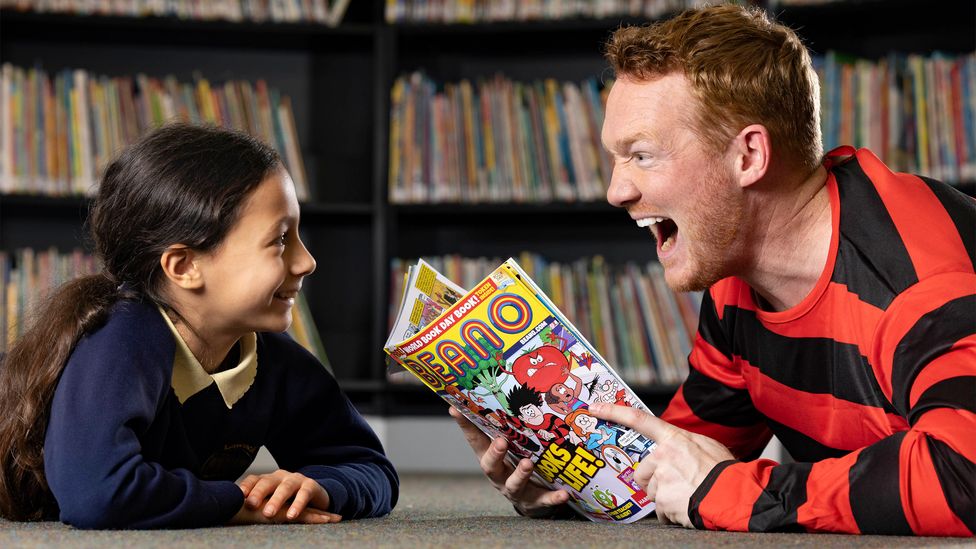
World Book Solar day celebrates the joy of reading, and has become increasingly popular. Here, British Olympic Gold Medallist Greg Rutherford joins in (Credit: Matt Alexander/PA Wire)
Studies also evidence that reading ability is more closely linked to a child's vocabulary than to their age, and that spoken language skills are a high predictor of later literary skills. However, we know that many children who enter school are behind on their linguistic communication skills, especially those from disadvantaged backgrounds. Some contend that formal teaching allows these children to access the support and skills that others may selection upwardly informally at domicile. This line of thinking is consort by Uk educational authorities, who say that teaching reading early to those behind on their spoken language is "the only effective road to closing this [language ability] gap".
Others favour the opposite approach, of immersing children in an environment where they tin enjoy and develop their language comprehension, which is after all central to reading success. This is exactly what a playful learning setting helps encourage. "The task of didactics is to assess where your children are and give them the nigh appropriate education related to their level of evolution," says Wyse. The 2009 Cambridge review echoed this and stated: "There is no evidence that a child who spends more than fourth dimension learning through lessons – as opposed to learning through play – will 'practise better' in the long run."
Cunningham, whose girl has also recently started learning to read, has a reassuringly generous view of the platonic reading age: "Information technology doesn't matter whether you offset to read at iv or five or half-dozen equally long as the method they are taught is a proficient, evidenced method. Children are so resilient they will find opportunities to play in any context."
Our obsession with early literacy appears to be somewhat unfounded, then – there's no demand, nor articulate do good of rushing it. On the other hand, if your child is starting early, or shows an contained interest in reading before their school offers it, that's fine too, as long as there is plenty of opportunity to downward tools and have fun forth the style.
* Melissa Hogenboom is the editor of BBC Reel. Her book, The Maternity Complex , is out now. She is @melissasuzanneh on Twitter.
--
Join one million Future fans past liking us on Facebook , or follow united states on Twitter or Instagram .
If you lot liked this story, sign up for the weekly bbc.com features newsletter , called "The Essential List". A handpicked pick of stories from BBC Future , Culture , Worklife , Travel and Reel delivered to your inbox every Friday.
Source: https://www.bbc.com/future/article/20220228-the-best-age-for-learning-to-read
0 Response to "What Age Does a Child Learn to Read"
Post a Comment